
Disclosure: This article may contain affiliate links and if you purchase I may receive a small payment.
You are allowed to want out. Let’s start there.
You can leave your job. You can walk away from the office grind and build an online business that actually makes money. But you cannot do it by “leaping.”
The internet loves romantic stories about the dramatic exit. The employee who finally snaps. They throw their keycard on the desk and walk out into the entrepreneurial unknown.
It looks great in movies. It is terrible in real life.
When you leap without a bridge, gravity wins. Most people who quit on an impulse end up trapped. They crawl back to a job after a few months, carrying a heavy dose of shame and financial panic. Or they survive, but only at the cost of crushing stress and burnout.
We hate uncertainty. It is wired into our biology. When you suddenly cut off your paycheck, your mind goes into survival mode. You stop thinking long-term. You start acting out of pure terror.
You cannot build a healthy business when you are scared about paying next month’s rent.
A real exit plan does not make things completely risk-free. Nothing does. But it replaces panic with simple, calculated steps.
We often wait for a perfect moment, assuming we need a complex spreadsheet to prove we are ready. But the realization that it is time to go rarely comes from numbers.
It starts with a simple feeling.
Enough is enough.
That feeling is a spark, but it is not a decision. A plan is what turns that raw energy into real momentum.
Why “Should I Quit?” Is the Wrong Question
When you feel stuck, your mind circles around one exhausting question: “Should I quit my job?”
It is a toxic question. It locks you into binary thinking. You convince yourself there are only two choices: stay miserably stuck in your chair forever, or take a wild leap into the dark.
It is a false choice. It forces you to choose between your safety today and your freedom tomorrow.
When you treat your exit as one giant decision, you run the sequence backward. You quit because you are tired. You instantly plunge into panic. Then you scramble to build a business from scratch under intense pressure.
This panic is why so many online businesses fail. You make desperate, short-sighted decisions. You burn through your cash. Eventually, you go back to employment feeling defeated.
Let’s flip the sequence.
Ask this instead: “Can I build a plan before I make the decision to quit?”
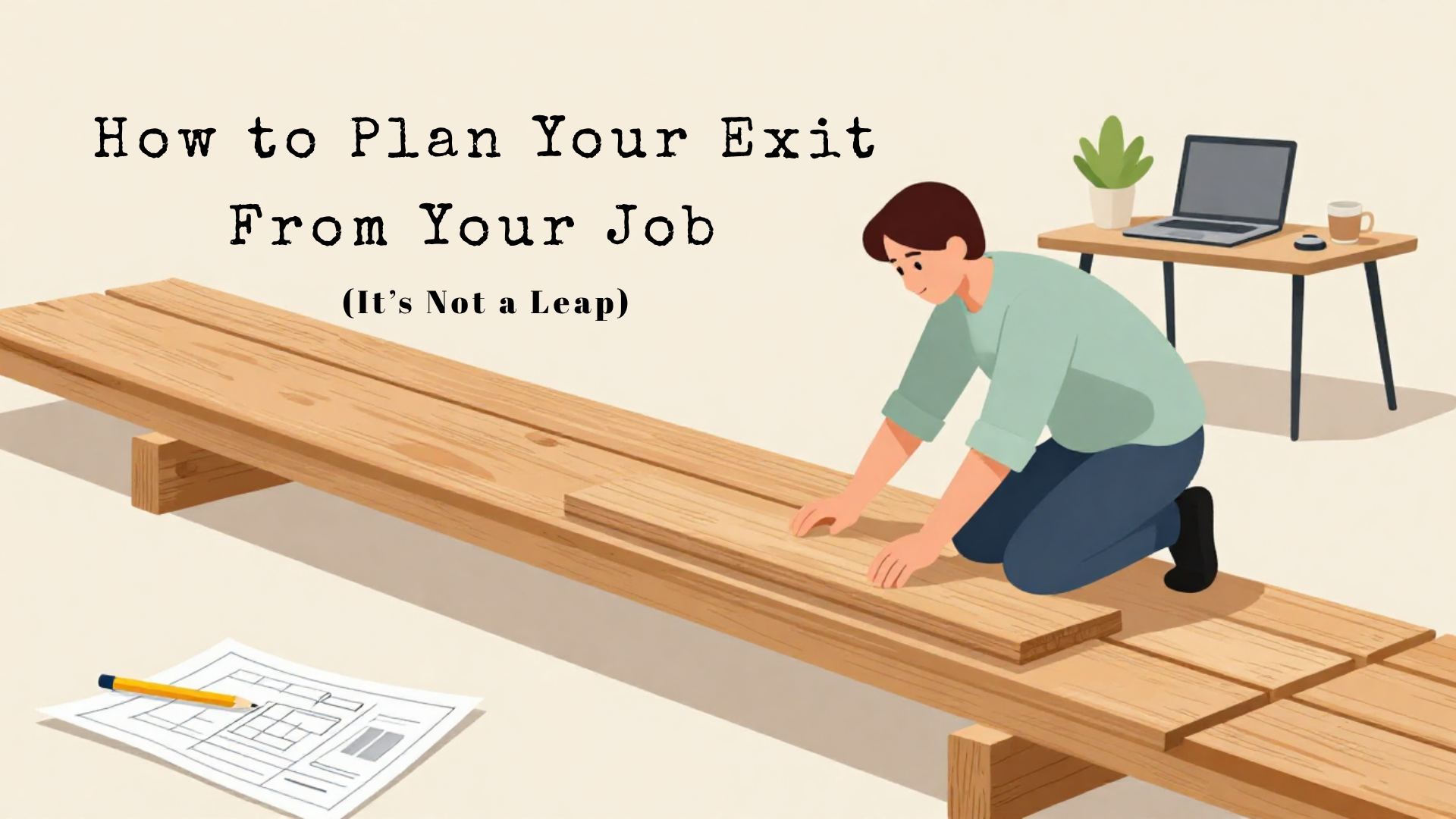
This changes the game. Instead of leaping and trying to stitch a parachute on the way down, you build a stable bridge while you are still getting paid.
You validate your ideas and set up basic systems while your downside is covered.
Earning even $\$500$ a month from your side project changes your head. It makes the dream real.
You get to learn, fail, and try again on your company’s dime, not your own. By the time you hand in your notice, the drama is gone. Your exit is calm and logical.
You are not deciding whether to quit. You are simply stepping onto the bridge you already built.
The Runway Math (Without the Fluff)
If you ask a career coach how to prepare, they will tell you to save six months of living expenses.
It is lazy advice. It ignores your life, your risk tolerance, and your business. A parent with a mortgage needs a different net than a twenty-something with roommates.
You need your exact number.
First, find your monthly burn rate. This is just your fixed survival costs (housing, utilities, basic food) plus your variable costs (the extra stuff you can cut the second you leave).
$$\text{Monthly Burn Rate} = \text{Fixed Costs} + \text{Variable Costs}$$
Once you have that, your runway is your savings divided by your monthly burn:
$$\text{Runway (Months)} = \frac{\text{Savings}}{\text{Monthly Burn Rate}}$$
If your minimum burn is $\$5,000$ a month and you want a $12$-month runway, you need to save $\$60,000$ before you act:
$$\$5,000 \times 12 = \$60,000$$
Staring at a $\$60,000$ savings goal can freeze you in place. It is why people never start.
To beat this paralysis, split your runway into two buckets:
- The Survival Net: Keep $3$ to $6$ months of absolute fixed costs untouched. This is not business capital. This is your sleep-at-night insurance so you know you won’t lose your home.
- The Business Runway: This is the money used to run your business and cover your lifestyle as you grow.
Here is how you speed things up: you do not need to wait until your job fully funds both buckets. If you build your business while employed, every dollar you make cuts down your timeline.
If your personal burn is $\$5,000$ a month, and your side hustle starts making a modest $\$2,000$ a month, your actual monthly deficit drops to $\$3,000$:
$$\$5,000 – \$2,000 = \$3,000$$
To survive for a year, you no longer need $\$60,000$ in savings. You only need $\$36,000$:
$$\$3,000 \times 12 = \$36,000$$
You just shaved months—maybe years—off your time in the office.
Quit when the math makes it irresponsible to stay. Real readiness is not about being rich. It is about removing the terror so you can make decisions with a clear head.
The Pipes to Lay Before You Leave
You cannot build a business while working full-time if you have to press every single button manually. If your business requires your constant physical presence, you do not have a business. You have a stressful, unpaid second job.
Before you resign, you need digital pipes that run quietly in the background while you are sitting in staff meetings. This is not about expensive software. It is about simple, unglamorous setups that buy you time.
You need three basic systems running on autopilot.
1. Automated Content
You cannot spend your limited evenings copying and pasting posts across five different networks. You will burn out.
Write once, distribute everywhere. Write a solid article on a Thursday night. Set it to publish on your site Friday morning. Schedule an email to go out to your list on Monday, and queue a few social posts for the next two weeks.
This is the plumbing of your business. It isn’t sexy, but it keeps you from drowning in busywork.
2. Simple Lead Capture
When someone finds your work at two in the afternoon, they are interested. If they have to wait until you finish your shift at six for a manual reply, they are gone.
You need a system that captures their email and delivers a warm welcome instantly.
Do not buy five different software subscriptions for this. You can run your entire setup on a platform like Systeme.io. It bundles landing pages, email lists, and automated workflows into one place.
It does the same job as high-priced alternatives like ClickFunnels for a fraction of the cost. Spend a few hours playing with the dashboard, and setting up these automations will become second nature.
3. Automatic Sales
When someone decides to buy your digital product or book a coaching spot, it must happen without you.
If a buyer has to wait hours for you to manually email them a file, your setup is broken. You need a loop where the customer pays, Stripe or PayPal processes the money, and the system delivers the product instantly.
Your only job should be looking at your phone and seeing that a sale happened while you were doing your day job.
These systems are the structural beams of your bridge. When your content, leads, and sales run automatically, you can show up to your day job without guilt. Your business is growing with you, not waiting on you.
The Five Real Signs You are Ready
“Am I ready?” is a bad question. It is too emotional. It depends entirely on whether you had a bad day at the office or a good one.
Do not base your life on a bad Tuesday. You need data.
Look for five real, measurable markers before you take the step.
- Consistent Income: Your business has made money—even just $\$500$ to $\$1,000$ a month—for three consecutive months. This proves people actually want what you are selling.
- The 12-Month Buffer: You have at least $12$ months of runway saved, using your side-income to offset the burn rate.
- Pipes on Autopilot: Your email leads capture and products deliver without you babysitting the software.
- A Live Focus: You have one scaling income stream that is already active. Do not quit expecting to launch three brand-new, untested ideas on your first day of freedom.
- Proven Grit: You have actually worked the late nights and early mornings. You know you can show up for yourself when no boss is watching.
How to Walk Out the Door
The dramatic exit is great for movies, but bad for business. Your departure should be the most boring conversation of your career. It is a transaction, not an emotional release.
Leave with grace. Keep your reputation intact.
The Conversation
Keep your talk with your manager short, polite, and focused on the future. This is not the time to complain about your boss or the company culture. You do not owe them a breakdown of your business.
Use a simple script:
“I am writing to formally give notice of my resignation. My last day will be [Date]. I have decided to pursue a new business venture. I am grateful for the opportunities I’ve had here, and my main focus over the next few weeks is to make sure the transition is completely smooth for the team.”
If they ask for details, hold your boundaries: “It’s an online business I’ve been building. I’m excited to focus on it full-time.”
Say less.
Protect Your Legacy
The business world is small. The people you leave behind today could be your clients, partners, or supporters tomorrow.
Finish your projects. Do not quiet quit. Build a simple transition guide for whoever takes your desk. Offer to train your team.
When you leave on good terms, you leave a legacy of professionalism. That is an investment in your future.
Your First 30 Days of Freedom
The day after you leave, the structure of the 9-to-5 is gone. Your calendar is empty.
You will likely feel a mix of relief, sudden panic, and imposter syndrome. This is completely normal.
Do not wake up on Monday morning asking yourself what you should do. Have your content queued, your daily routine set, and your tasks laid out before you ever hand in your notice.
The physical act of leaving takes thirty seconds of courage. The real work is the planning you do beforehand.
Build your runway. Lay your pipes. Quit when the math says it is time.
The bridge is right in front of you. Step onto it and start walking.